It's Friday and you know what that means.
We’re getting closer and closer to our “Eras” Show at Hootananny Inverness on the 20th of November.
In the run up, as well as thinking about the music. I (Big Sexy) have been reflecting on how my equipment has changed over the years. So I figured I would give a little “Rig Rundown” (don’t tell premier guitar! :P) of my set-up over the years.
I grew up in a very musical house, my dad was a professional drummer. He liked to fill the house with instruments for us to use and discover what we liked to play. So Growing up I always had access to a bass to mess around with. I learned bits and pieces and a few tunes but I didn’t pay full attention to I was older. One year I got together with some friends and Jammed some covers at a Hogmanay party. In the following months I was gifted my first bass for my 21st birthday.
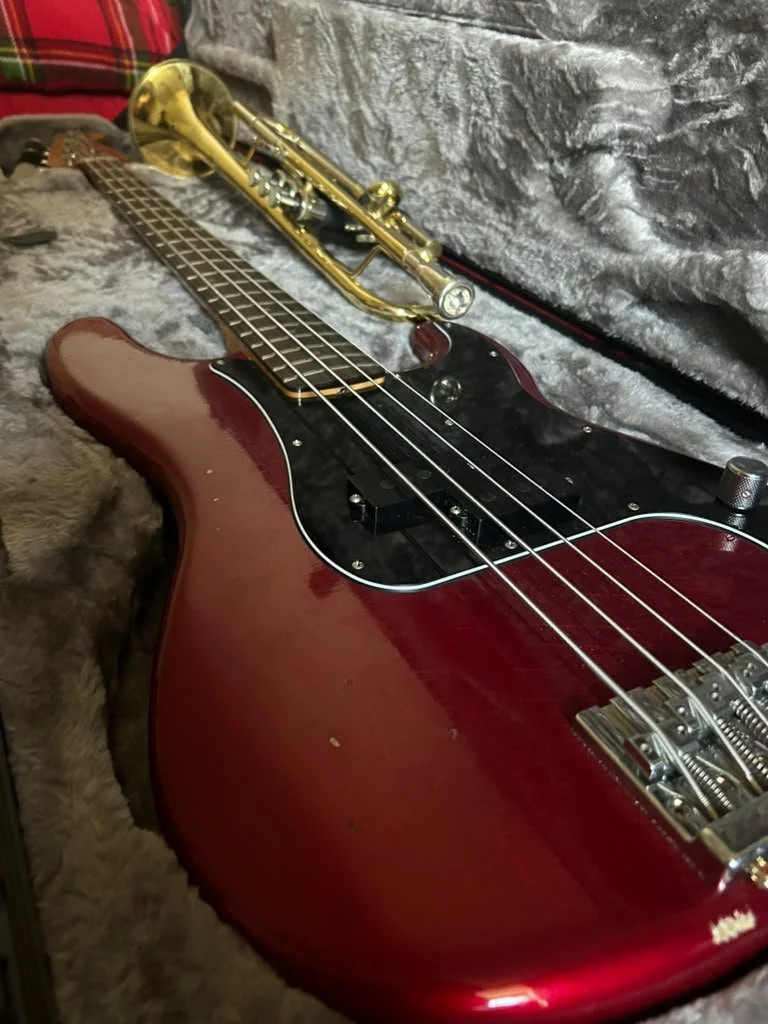
Jack’s P Bass, which he used on ‘Hard Times’.
It was a P Bass, affordable but it was mine. I changed the pickups and upgraded the wiring. It sounded awesome and It was my main bass for many years. To this day, even when compared to ‘Better’ instruments. I will pick it up and it feels like home.
P Basses are stylistically versatile instruments. You look in most recording studios and there will be one on the rack. And until recently I played them almost exclusively.
All of “Hard Times” was recorded using P basses. The majority was my old faithful.
In the past year I have started exploring a little. To find something a little more unique? or maybe just chasing novelty. When I started developing tendon issues in my wrists (Summer of 2025), playing bass for longer periods became quite painful. I needed to look for a solution to allow me to perform whilst reducing strain. This lead me to look into short scale basses.
The scale length of a bass is the length between the nut and the bridge. The standard scale of a bass is 34” and short scale bass is 30”. The shorter scale tuned to the same pitch results in less tension in the strings as well as the frets being closer together.
This search resulted in my purchasing a Gretsch Junior Jet Bass. Very Similar to the basses played by Mike Kerr of Royal Blood, but in shell pink. (Rikki still insists that it is white, Rig Edit - “it is”.)
The comfort was immediately apparent but what I did not anticipate was the inspiration that it would bring.
Within weeks of buying the Gretsch, “Paper Tiger” had been written. A bassline very different to anything that I had written previously. Both style of playing and the tone rabbit whole it sent me down. More on that later.
Fast forward to this summer 2026. I was in Stirling visiting some friends and we were in town looking for a place to have lunch. We walked past a little independent music shop called Joanie’s Music. I popped in to have a look around. And on the wall was a bass that immediately caught my eye. An Ashdown Saint in Ice Blue.
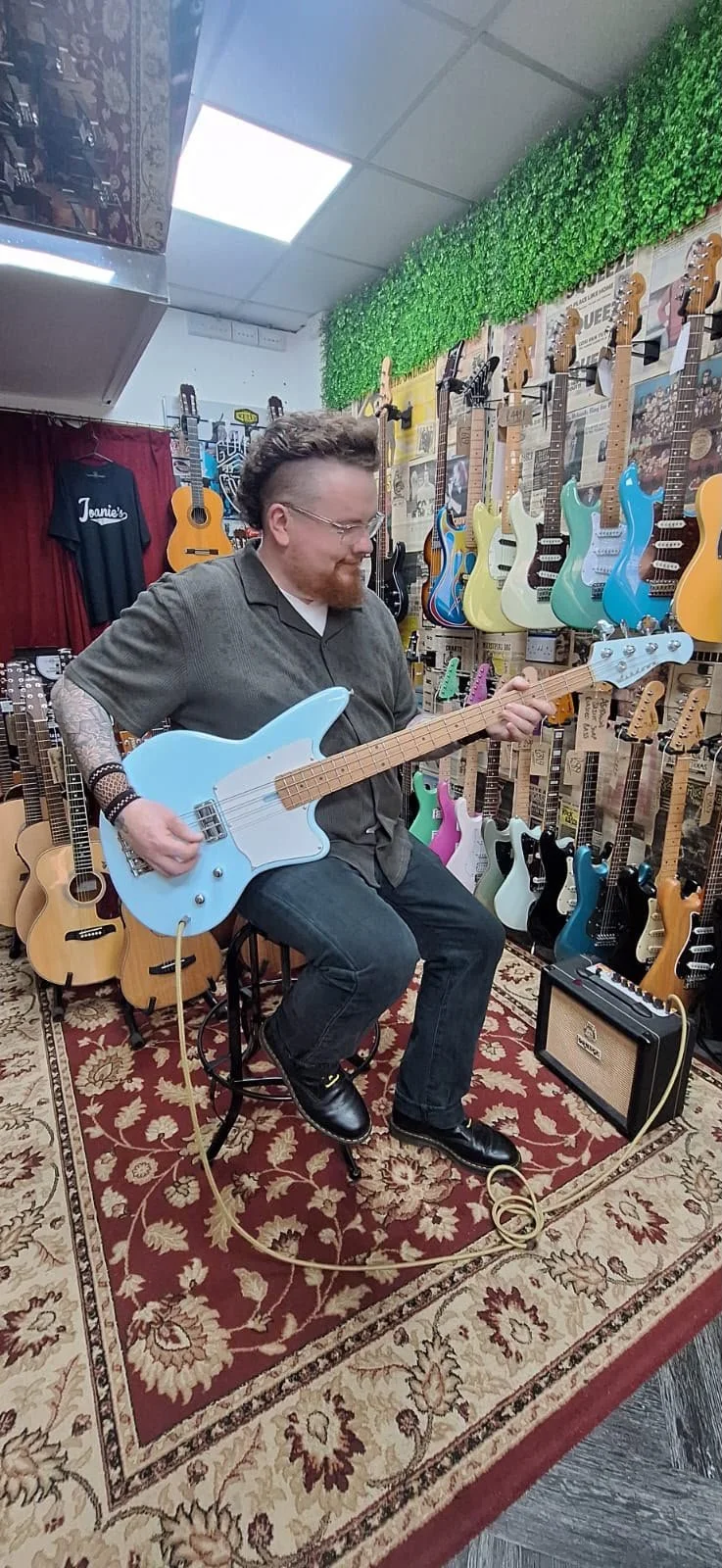
Jack finds his Ashdown
Ashdown are known as a bass amplifier company and I had seen online that in recent years that they had branched out into Bass Guitars and that they had been very well received. Well let’s just say that 20mins later I waked out the shop, bass on my back and very happy! It Sounds like a mix of a P Bass and a Stingray. And with a very unique look. It is my primary gigging bass for now and is being used in the writing of new songs (watch this space). Also, don’t tell anyone but I might have another Ashdown bass on Pre-order!
Many bass players preach simplicity, that all you need is a Bass Tuner and an Amp. Insistent that all the tonal variety you need comes from the fingers and amp settings. Maybe a compressor if they are feeling spicy. I do not follow this mindset, well not fully anyway.
Very early on in my bass journey I was drawn to the bass sounds of the 80s laced with modulation and sharp attack such as “Love Will Tear Us Apart” by Joy Division. Which introduced me to the two fundamentals of my bass tone that have remained a constant. Playing with a pick and Chorus.
Chorus is a type of modulation. The nutshell version is that it changes (Modulates) the pitch of the sound and mixes it back in with the original causing a “Wobbling” sound. When used more subtly, it has the effect of fattening the sound but also adding a sparkle to the top end.
This lead me to my first “real” setup.
Tuner -> Overdrive -> Chorus ->Amp
The amp in question was an Ashdown Root Master 240 into a 2x12 Cab.
This was the only bass amp I have owned. However most of the time, I was using the house backline for simplicity.
This gave me the modulation I wanted but it didn’t have the “knock” or “punch” to the tone that I wanted. I tried compressors and they didn’t do it for me. And after much research (Mostly watching YouTube videos) I found the answer. A bass driver DI Pedal.
The one that everyone talked about was a Tech21 Sansamp but they were out of my budget.
So I found a cheap equivalent as a temporary solution. And as is the case with a lot of things. There is nothing more permanent than a temporary fix.
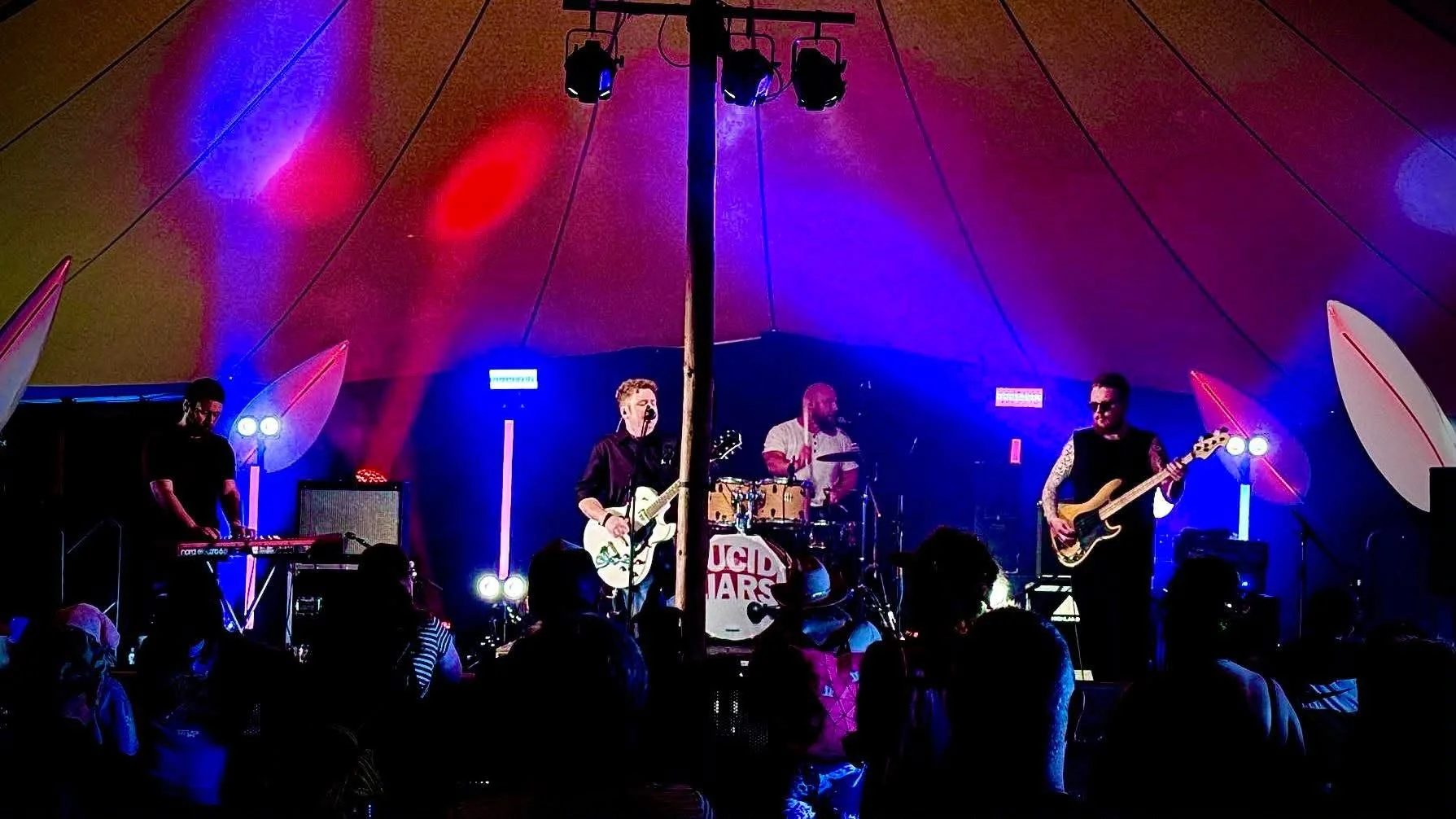
Jack on stage with the band using Old Faithful
At the same time Lucid Liars was transitioning from using amps on stage to an amp-less setup. Where the guitars and bass are given direct to Front of House without need for an amplifier. This gave us much more control and consistency over our sound but also saves a load of room and weight when travelling for gigs. Another benefit is lower stage volumes as we use In Ear Monitors. Allowing for a much clearer Mix out Front.
Then we get to looping.
During the recording of “Hard Times” (Both the track and album) I recorded a lot of brass parts (I am a trumpet player) not really thinking about the practicalities of playing live. I probably just assumed that the brass would be on playback along with the synths etc.
But we soon realised that live trumpet would be really cool both as a gimmick and allowing me a moment of melodic expression as well as just being fun. This presented a challenge however. I only have two hands. And I wasn’t happy with the idea of Bass dropping out / not being present in a song to allow trumpet to be there.
Rikki who has been looping guitar as part of the Lucid Liars sound for years made the suggestion that I try it. He let me borrow one of his spare loopers. After a learning curve and some ongoing mental gymnastics to figure out the arrangements we are now able to have pretty seamless bass and trumpet.
So since early 2025 Lucid Liars my Pedal Board was
Tuner -> Over Drive -> Chorus -> Looper -> Driver DI
That was until I fell down the tone rabbit hole!
As I said above the writing of “Paper Tiger” converged with the purchase of my Gretsch. I was excited with my new acquisition and I stared playing. Literally like a child with toys. Experimenting with tones and wild sounds. Using Plugins on my computer to distort and warp the sound. I discovered ways to make the bass almost sound like a Synthesiser.
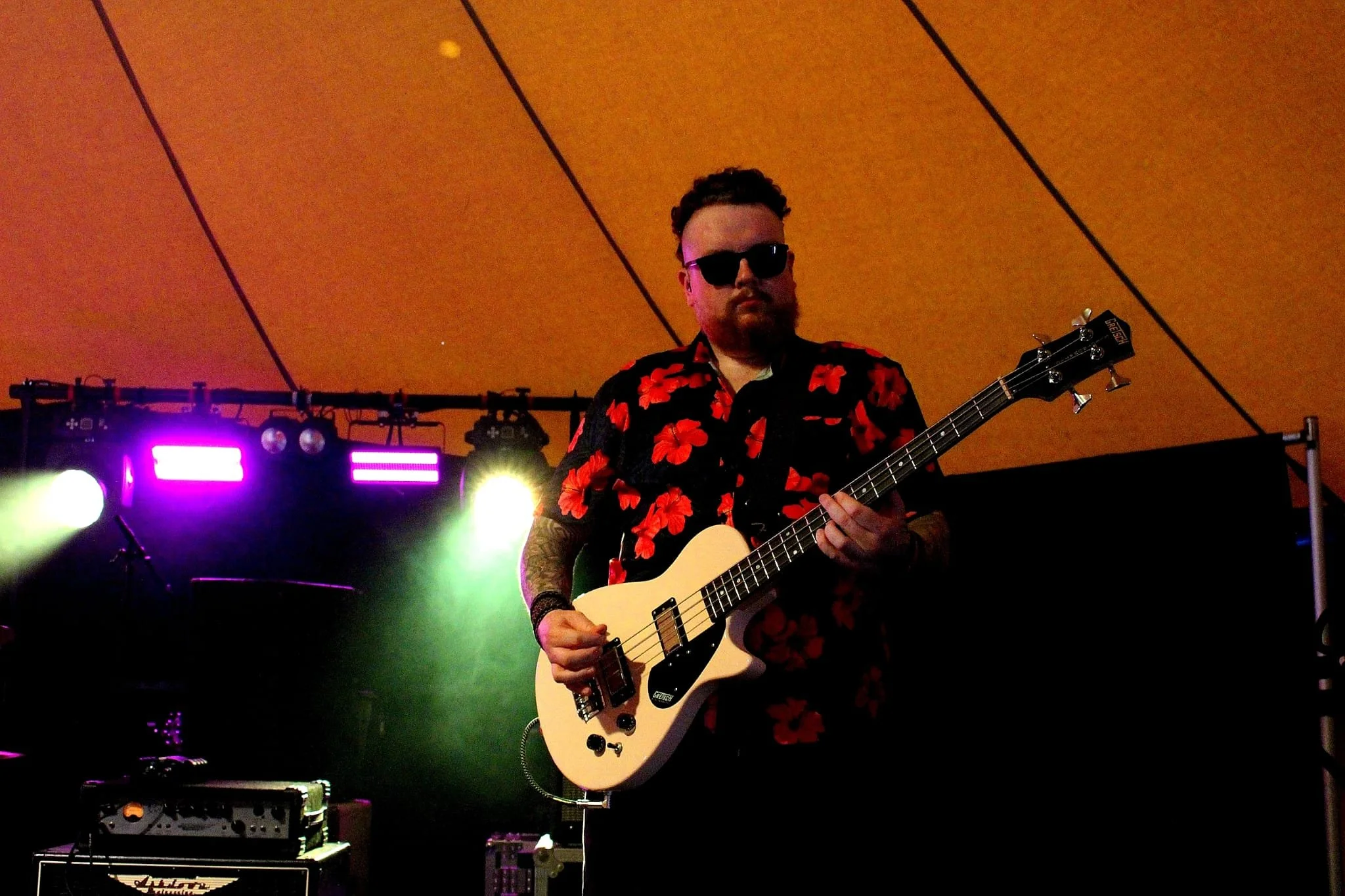
Jack at Belladrum 2026 with his pink Gretsch (picture here clearly white)
When Rikki sent over the demo for “Paper Tiger”. I approached it with the same sense of play. And what you hear on the record is pretty much first or second take madness.
I sent it over to Rikki expecting to be told to calm down a little. But everyone Loved it!
Answering that question has arrived at the set-up I have today. I dove back into the YouTube research and found a series of videos by Iain Martin Allision of Scott’s Bass Lessons demonstrating the flexibility of the HX Stomp By Line 6.
The HX stomp is a multi-effects processor for guitar and bass. Including affects and amplifier modelling that can be utilised very flexibly to achieve practically anything that you want.
It seemed to be the golden ticket. So I pulled the trigger and built my current pedal board.
HX Stomp -> Looper - > DI Box
The HX Stomp now does all the work. And has opened all the doors in terms of tone shaping and madness. Still using the same looper on loan from Rikki. And the high quality DI Box that is on my pedal board makes sure I am sending a predictable signal to front of house.
Now in the post “Paper Tiger” era. You can expect anything from 80s punchy bass tones to full synthy madness. I love it and it excites me and inspires new ideas. It has also brought a new life to songs we are bringing back for “Eras”. Can’t wait to hit the stage at Hootananny and show you all what we have been cooking up!